
In the last blog, I went over the basic concepts of mesh networks. And for those who are just jumping in we are using Meshtastic as our software which transmits on LoRa.
My goals of today’s project
I would like to create a central base station where I can communicate to other nodes. In the future I would use this as a repeater or relay node to extend the range of my communicators. I would also like to include some telemetry data using the python CLI in the future that can be uploaded to a basic HTTP server that I can access to view battery voltage, Channel usage graph and up time.
But before I get ahead of myself, after all we are building mesh network. I just cant do what I just mentioned all at once. We have to take it like climbing a ladder, one step at a time.
The next step
The next step in creating this network is to improve our local area RSSI and transmission speed. If we go onto the Meshtastic website, and look at modem speeds, the following modes look promising for my use case.
| Radio Preset | Alt Preset Name | Data-Rate | SF / Symbols | Coding Rate | Bandwidth | Link Budget |
| Medium Range / Fast | Medium Fast | 3.52 kbps | 9 / 512 | 4/5 | 250 kHz | 148dB |
| Medium Range / Slow | Medium Slow | 1.95 kbps | 10 / 1024 | 4/5 | 250 kHz | 150.5dB |
If I am planing on building a mesh network of a decent size, we need to take a few things into account.
How much area am I planning on covering?
Well in order to answer that question I need to take a look at what I plan on making. There is a creek nearby that I have a Mino trap in for fishing. It would be nice to have a sensor hooked up to the mesh network tell me if the creek is flowing or not, maybe along with water temperature sensor. Well this is about a good 170 yards from the attic where I plan on putting that central node.
Another project I might build to add to the mesh network at some point is a automated weather station that reads humidity, temperature, and maybe wind speed. I would probably put that in the yard away from the house so It can get accurate temperature reading an wind readings.
The furthest I should have to transmit is about 200 yards give or take. Meaning that we don’t always need maximum power, after all there are other people that use these frequencies and we don’t need to be interfering with them. Another thing I should mention is if you look Meshtastic software there are these things call channels. So If I have the creek monitor on its own channel, and the weather station on its own channel. By doing that I can prevent them from interfering with each other on the mesh network.
Creating the base station
A base station is where the control point is. In this case our control point is where we are keeping the mesh node. I have the node hooked up to my desktop through a USB to serial connection. From here I can flash the node and configure the setting.
New Parts inbound
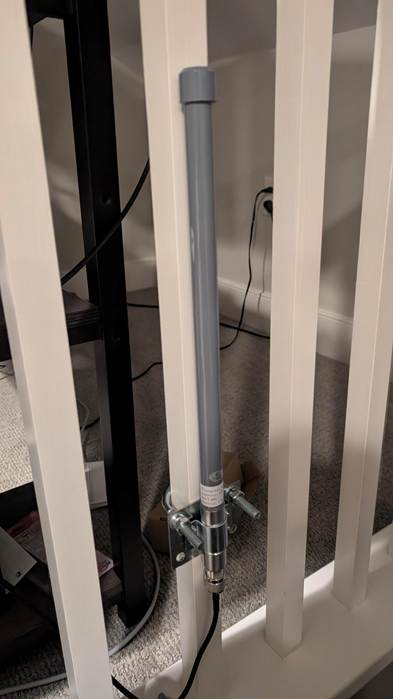
I decided to buy a 5.8dBi gain antenna. I didn’t have a place to mount it outside so I found a spot on a railing to mount it. Yes I understand this isn’t and ideal mounting spot for an antenna but its going to have to do for now.
Testing
I chose to do another range test on Long slow so we have something to pit the new antenna against.
| 50 yards | 140 yards | 230 yards | |
| Stock antenna w/ stock antenna | RSSI: 39 dBm | RSSI: 89 dBm | RSSI: 97 dbm |
| 5.8 dBi antenna w/ stock antenna | RSSI: 56 dBm | RSSI: 75 dBm | RSSI: 75 dBm |
You might notice how with the new antenna we have a increase in dBm over the old antenna at 50 yards, this noise interference. Its something that we are going to have to take into account and accept when trying to test. But when it comes to retaining signal quality, its obviously goes to the new antenna.
Let me be clear though, I am not saying you should get rid of the stock antenna’s completely. If your under 200 yards they do just fine. What I see the most affecting range the most is walls and other physical obstructions like tree’s. Having some performance enhancements might be nice for your mesh network
However having this other antenna changes things a little bit.
My final thoughts
Overall I was impressed with the performance of the mesh network. I had conducted one final test. That was pushing it as far as I could. I managed to do 0.43mi with an RSSI value of -125dBm. I defenatly plan on expanding this with some weather sensors and using them to communicate when out in the woods and it doesn’t make sense to use a voice radio.